
Legacies & bequests
A last will that makes a real difference
By leaving a legacy or bequest, you can help ensure that children and adolescents with cancer continue to have access to the most advanced treatments. Your legacy supports SPOG’s patient-oriented clinical cancer research in the long term – beyond your lifetime.
Every year, around 350 children and adolescents in Switzerland develop cancer. Almost 90% of children and adolescents with cancer now survive the disease. Nevertheless, some families still lose their children. That is why childhood cancer research remains essential. Further progress depends on people who support this research and remain committed to it over the long term.
SPOG coordinates clinical childhood cancer research in Switzerland and works to ensure that children and adolescents have access to the best possible treatments. By including a provision in your will, you can leave part of your estate to clinical childhood cancer research. With the free will generator from our partner DeinAdieu, you can draw up your will in just a few steps. You can find more information in our guide to making a will below.
Do you have any questions? We will be happy to advise you.
Why does childhood cancer research need long-term support?
How can you proceed?
Get answers to your questions
The SPOG guide to making a will answers your questions about legacies and bequests – from compulsory portions to a glossary of key terms. This will give you a clearer idea of how you would like to use your assets.
Put your intentions in writing
With the free generator from our partner DeinAdieu, you can create your will step by step. Simply copy the finished text by hand and sign it. This makes it legally valid – even without notarisation.
Store it securely
With the free DeinAdieu advance care dossier, you can organise your patient decree, advance care directive and will in one place. It is securely stored on Swiss servers, valid without notarisation and can be amended at any time. This gives your family greater peace of mind.
Frequently asked questions
Open communication is the key. Tell your family as soon as possible that you would like to support SPOG and find out what their expectations and needs are.
Yes, if you donate to SPOG you can specify the purpose. Get in touch with us at an early stage so that together we can find a solution that is practicable in the longer term.
No, as a non-profit organisation SPOG is exempt from inheritance tax. Your donations and gifts go straight to our studies.
Statutory heirs limit your ability to dispose of your assets. Calculate your freely disposable portion anonymously on www.deinadieu.ch/en.
Without a will, your estate will be distributed according to the law. If there are no heirs, your estate will revert to the state in full.
A patient decree records your wishes for medical treatment in case you are no longer able to communicate them yourself. It relieves the burden on your family and gives doctors clear guidance.
An advance care directive is a written document that specifies who should handle your personal, financial, and legal affairs if you lose the capacity to make decisions for yourself. It takes effect once you can no longer make decisions for yourself and the directive has been validated by the Swiss Child and Adult Protection Authority (KESB).
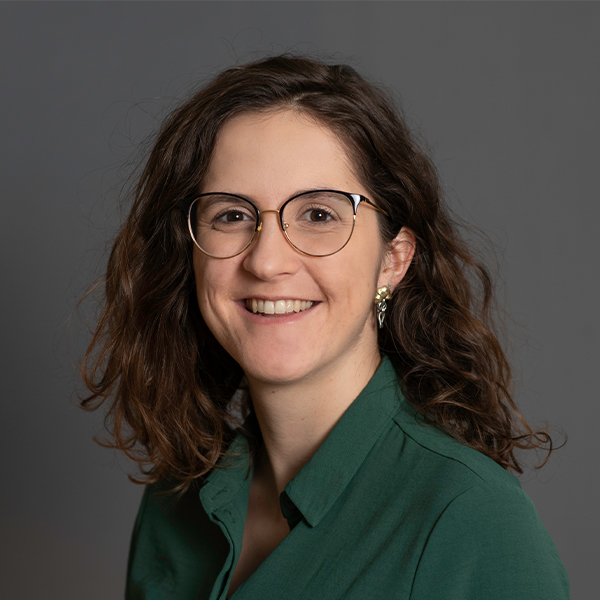
Your contact person
Flora von Holzen is deeply committed to supporting children and adolescents with cancer and is your personal contact at SPOG for legacies and bequests. She has worked in institutional fundraising at SPOG for around seven years and now oversees this area as Deputy Head of Partner Relations.
Whether you are just beginning to consider your options or already have specific plans, Flora von Holzen will be happy to provide confidential, no-obligation advice in German, French, and English.