âFar more than just a milestone in time: half a century of dedication, collaboration and progress in the care of children and young people with cancer. Thousands of young lives that have been saved, prolonged or significantly improved â thanks to your dedication.â
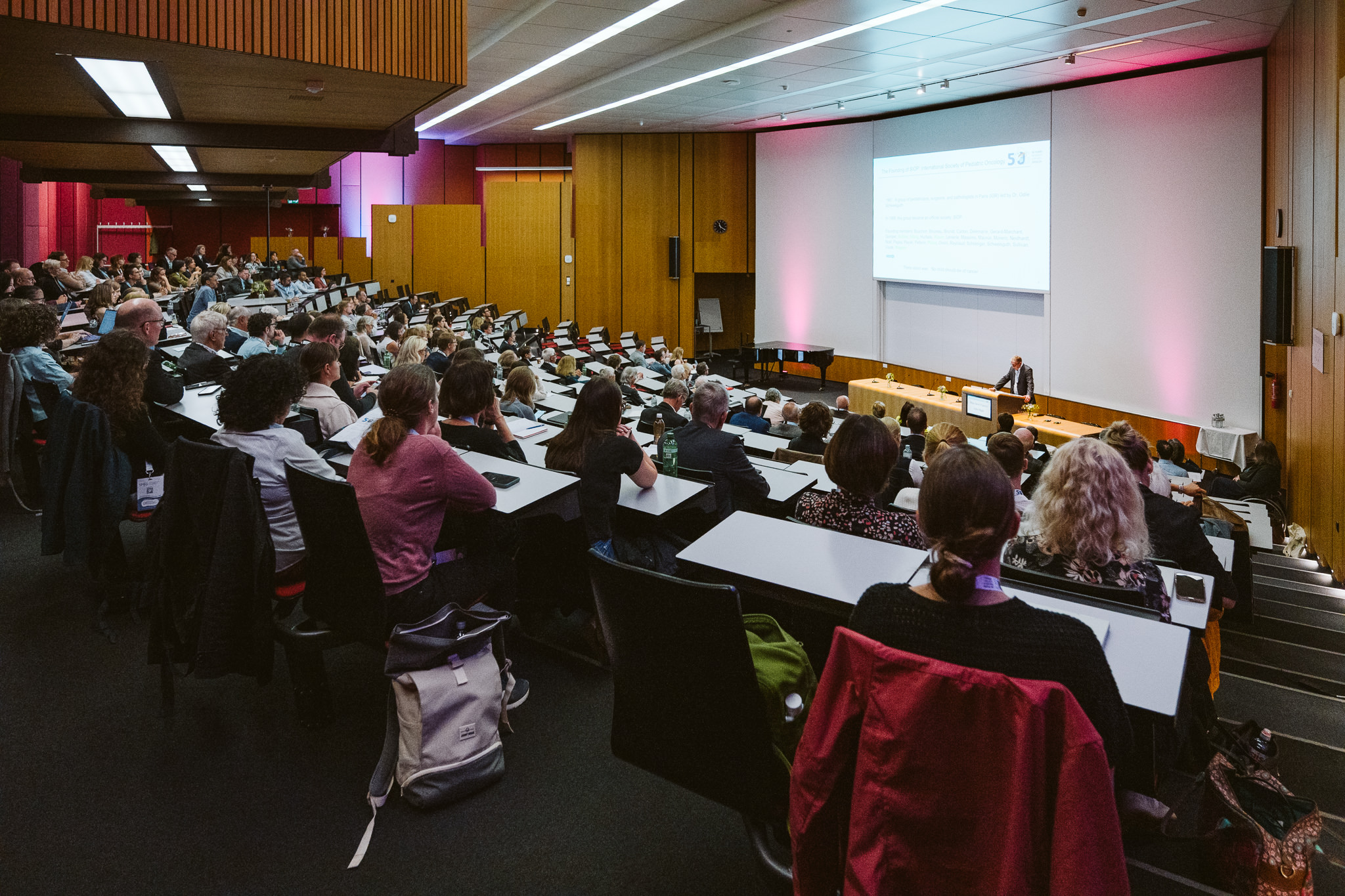
With these words, Salome von Greyerz, Head of the Department of Health Care and Professions at the Federal Office of Public Health, opened the series of official welcoming addresses at the SPOG Anniversary Symposium. On 5 June, all those involved in âpaediatric oncology in Switzerlandâ gathered in Bern for the event, with around 200 people in attendance. Katrin Scheinemann and Nicolas Gerber, President and Vice-President of SPOG, skilfully guided the proceedings throughout the day.
Broad collaboration and effective coordination
Nicole Schaad, Head of the National Research Division at the State Secretariat for Education, Research and Innovation (SERI), described SPOG as âa cornerstone of paediatric oncologyâ. In the complex and constantly evolving field of childhood cancer, she said, effective coordination and sufficient critical mass are essential. Schaad went on to say that the long-standing financial support from SERI is a clear recognition of SPOGâs outstanding scientific work. The network knows how to translate public investment into measurable benefits for society and for patients.
Manuela Weichelt, Member of the National Council and board member of Kinderkrebs Schweiz, highlighted the high survival rate of over 87 % among children and young people with cancer in Switzerland. She emphasised the importance of collaboration between researchers, policy-makers, organisations and families.
How it all began
Professor GĂŒnter Henze, long-standing head of paediatric oncology and haematology at the CharitĂ© in Berlin, provided an insight into 50 years of research. In 1972, he noted, almost every child with acute lymphoblastic leukaemia had died. At the time, no none could have imagined that one day over 90 % of young patients would survive. It was cooperation, not competition, that had made this progress possible.
Improving survival rates worldwide
Felix Niggli, former SPOG President, pointed out that high survival rates are only achieved in high-income countries. In middle- and low-income countries, the survival rate stands at 20 %. Maja Beck Popovic, Professor Emerita at the Lausanne University Childrenâs Hospital, presented, among other things, the WHOâs âGlobal Initiative for Childhood Cancerâ. She also recalled the humanitarian commitment of SPOGâs founding father, Hans-Peter Wagner: as early as 1993, he established a committee within the International Society of Paediatric Oncology (SIOP) to help countries with limited resources improve cancer treatment for children.
Sustainable funding
SPOG President Katrin Scheinemann and Director Isabelle Lamontagne-MĂŒller presented todayâs SPOG with evident pride and enthusiasm. They emphasised how important sustainable funding is to ensure that a study â and with it the treatments carried out within it â can be seen through to the end. They would make this promise to patients and their families.
Â
Significant progress has also been made in study designs
Not only have diagnostic and treatment methods improved enormously, but study designs have also undergone significant development. This was highlighted by Pamela Kearns, Professor Emerita at the University of Birmingham. The challenge, she explained, is to determine the best course of action despite the small patient groups involved in clinical trials. Modern study designs have made this possible.
A revolution is underway
Although four out of five children survive cancer, further research remains a priority. Jean-Pierre Bourquin, Professor at the University Childrenâs Hospital Zurich, explained the reasons: on the one hand, childhood cancer is still the leading cause of death from disease among children; on the other hand, at least a third of children suffer lasting long-term effects from the toxicity of treatment. Bourquin described todayâs rapid developments as a ârevolutionâ. The new National Centre of Competence in Research âChildren and Cancerâ makes it possible to better understand the biology of childhood cancers and to find new, tailored therapies.
Real benefits for patients and their families
Which studies are truly important for patients and their families? The âpatient advocatesâ had the final say. They are organised within the âSPOG Patient Advisory Boardâ. Nicole Seiler, Nicole Scobie and Paul Castle introduced the newly formed board. The Patient Advisory Board acts as a âbridgeâ between patients and their families and the medical staff. The patientsâ perspective is another piece of the puzzle that drives paediatric cancer research forward.
The symposium concluded with a wonderful musical finale featuring Brahms. It turned out that outstanding clinicians and researchers can also be very good musicians.